

Effat was smoking on the tiny balcony outside her office. The one with terrazzo tiles and the dozens of discarded cigarette butts from the past two days. It was still humid and breathless outside, as if the air were trapped in a jar. But alone on that balcony, with the shitty view of the generators and the zigzagged cable wires, she was at peace. A peace that took over thirty years to arrive.
When Shakeeb knocked on the balcony door, Effat turned around and, seeing the sad look in his hazel eyes, like a child who had lost his mother, felt a thrill. Finally, she thought. But she had to behave in front of Shakeeb, who expected the wife of Mr. Bader to be a certain way. “Madame,” he said. “He’s gone — the one who didn’t let any of us grow hungry is gone.”
All Effat heard was ‘gone,’ and the ‘o’ sounded like a whole universe, one of infinite possibilities. Dizzy and shaken by the excitement of the life ahead, she burst into an uncomfortable fit of sobbing so intense that Shakeeb was instantly overwhelmed. Hearing the wailing, Vera, on the floor above, leaned out the window and said, “What happened?” Before Effat could answer, the neighbors were at her doorstep, and she continued sobbing as if rivers were inside her, never-ending.
“May he rest in peace,” Vera said. She wore her pink silk pajamas, which cooled Effat when she hugged her. Effat cleared her throat and tried to speak, but when she did, she laughed, and the neighbors again thought she was breaking down. Saleem, the neighbor on the fourth floor, ran to the kitchen and handed her a cup of water mixed with orange blossom. “For the nerves,” he said. Effat thanked him, gulped it like a tequila shot, and took a few long breaths.
Saleem, Shakeeb, and Vera stayed there for an hour, switching between gawking at her and consoling her until Effat couldn’t take it anymore. “I need some time to myself before I can go to the hospital,” she said.
“Of course,” they all replied, then left the room.
When the door closed, she locked herself in the room and said, “Siri, play Musica Leggerissima.” Siri obliged, and when the chorus hit, it was as if she were back at that bookstore in Milan, near the river, where she first discovered the song and felt on top of the world. She shook and jumped, singing with a joy she hadn’t felt in decades. When the playlist shifted to Madonna, she shuffled around her tiny office among the tossed manuscripts — among them the one she called Beirut, Once More, the book she could never finish because she was always tending to his aching legs and declining brain.
After dancing for a while, she sat on the brown leather sofa and put her legs on the yellow ottoman. She closed her eyes, and the possibilities of the new life ahead attacked her like a swarm of manic wasps. She could sleep without hearing his snoring, which was louder than a construction site. She could go to the beach down the road because she didn’t have to worry about him burning and complaining about people. “There are too many people,” he always said in his phlegmy voice, even if there were only three people in the room.
She sat there, daydreaming, until the neighbors came to the door again. When she heard them, she let out a loud cry, as if someone had just stabbed her, because that’s what they expected. They only saw the generous side of him, constantly handing out money from his wallet and checking in on everyone’s kids. Convinced by her cry, they said, “Be patient; it’s all in God’s hands.”
“I’m going to call my kids,” she said. And she did, calling her son Fadi in Dubai and her daughter Janna in Paris, both of whom were performing as she was.
About an hour later, just before she hung up on Janna, someone knocked frantically on the door again. It was Shakeeb, yelling, “Madame, madame, please open.”
She stood up, looked in the mirror at her puffy face and messy hair, and quickly brushed her hair. She opened the door, and Shakeeb wore a wide smile.
“It’s a miracle,” he said.
She could feel her chest closing in, but didn’t give up just yet. “What miracle?” she asked.
“They were about to take him off life support, and he suddenly woke up,” he said.
“Oh,” she said, standing still for a minute. The neighbors gathered around her again, gawking, and suddenly she began to laugh in a dazed way as if she was coming off morphine. They patted her on the back, thinking she was so happy that her good man had returned. Saleem took her to the kitchen and gave her more orange blossom water and a few zaatar crackers. “For blood sugar,” he said.
“It’s good news,” she said, sitting in the white plastic chair at the corner of the kitchen, the loneliest corner in the world. “Good news.”
The neighbors were quiet for a while until Vera broke the silence, saying, “Let’s go change. We will leave together and surprise him. He loves a crowd.” Shakeeb and Saleem nodded, and they left the house.
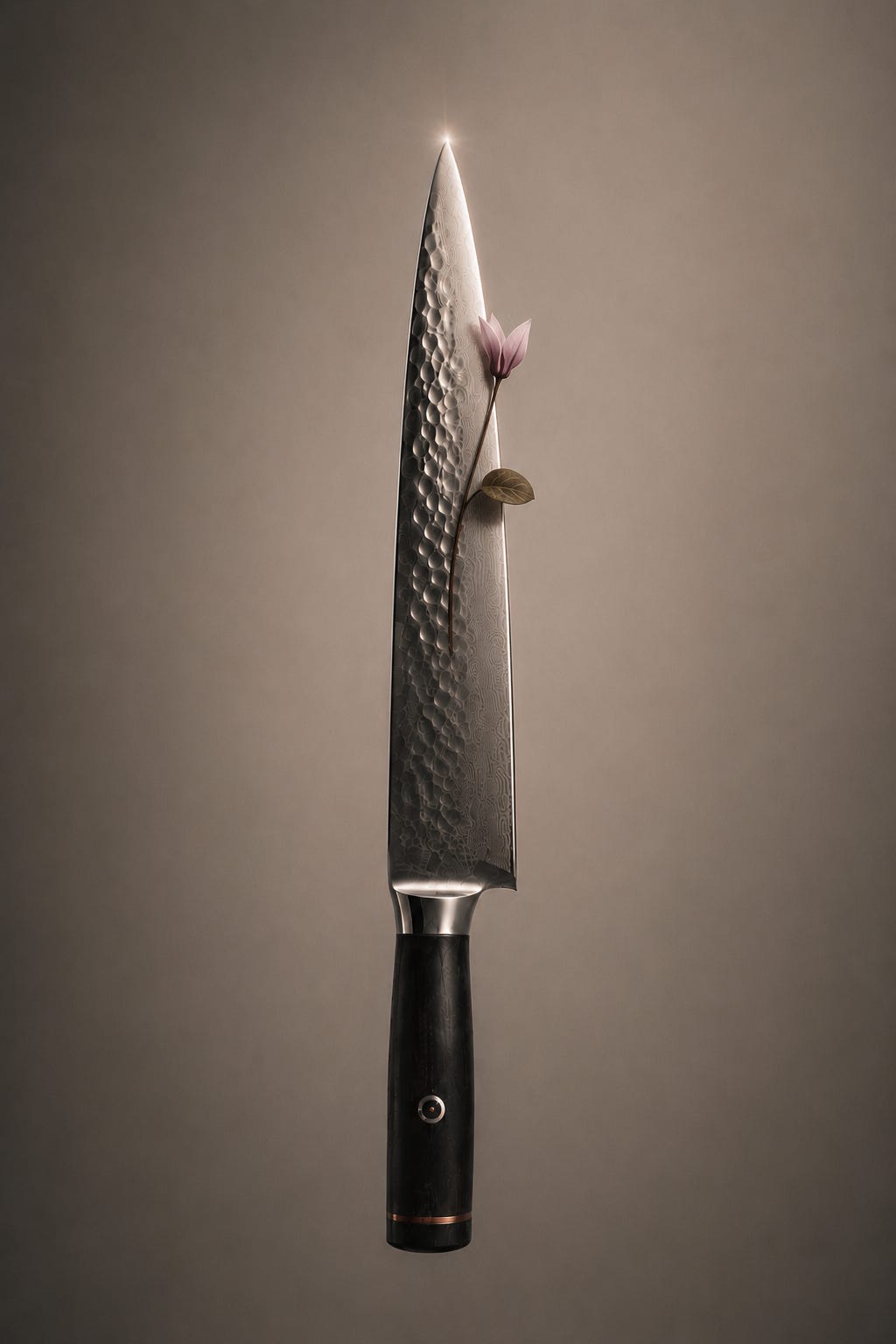
When they closed the door, Effat stomped her feet and yelled, “Fuck you.” She didn’t know who it was for, but she felt someone or something out there was trolling her. She got up to change, set the plate on the marble counter, then remembered the knife. The sharp one she bought in Tokyo, when he refused to leave the room because the way people were in a hurry made him uncomfortable. She opened the drawer, and the silver blade shone like a diamond. She took it to the room and put it in her purse, next to a small bottle of Tom Ford perfume and many keys. Maybe, just maybe, she thought she might need to finish the job herself.
Jacob Russell recommended you and sent me your latest piece. I loved it.